
AI Fatigue: Why You Feel Exhausted by AI and How to Fix It
2026-02-22
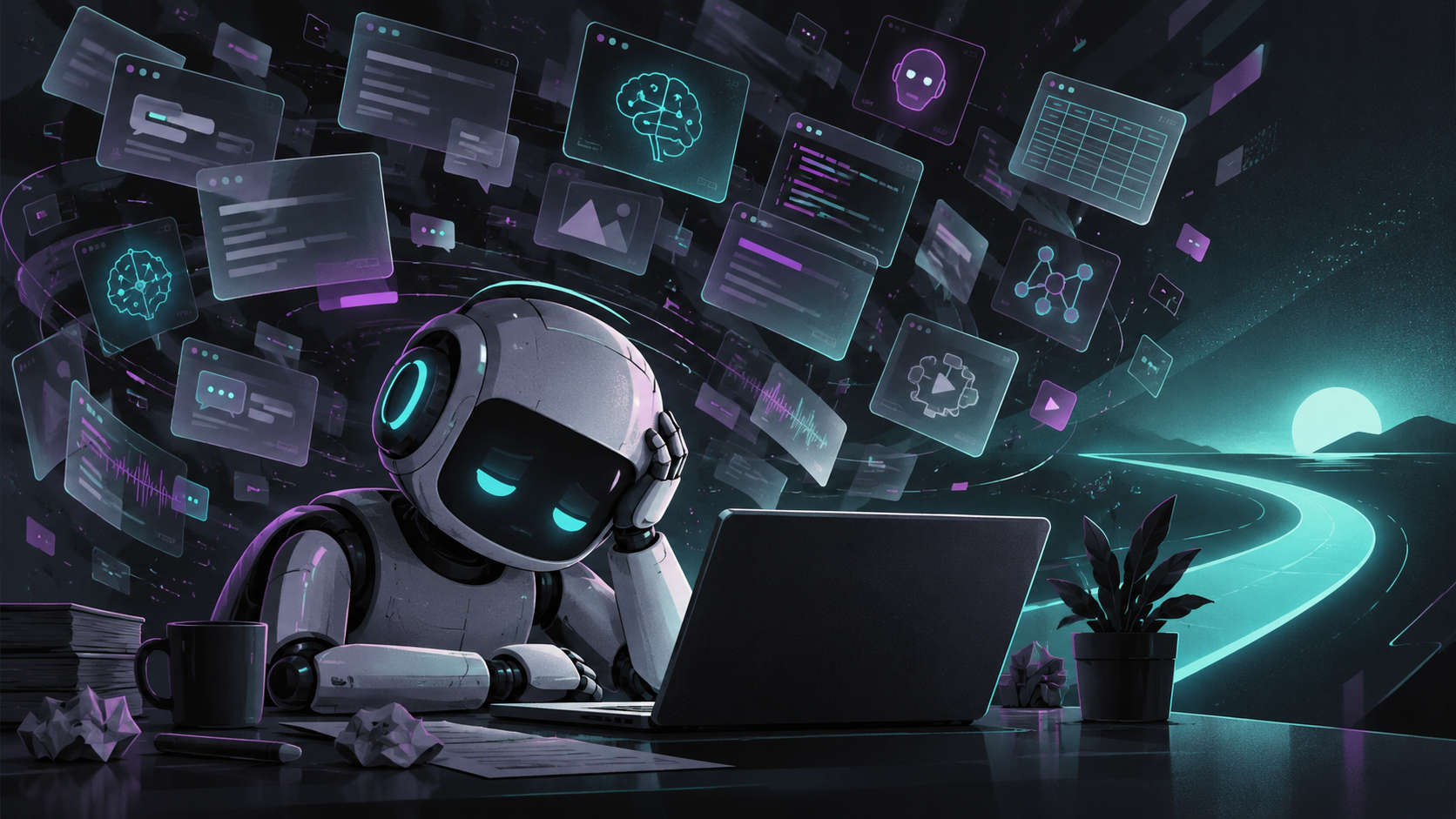
You open your laptop. A new AI model dropped overnight. Your Slack has three threads about a framework you never heard of. Someone on LinkedIn says you need to learn agents or you will be irrelevant by Q3. You close the laptop.
That feeling has a name. It is called AI fatigue, and it is spreading fast through every industry that touches technology.
A 2025 S&P Global survey found that 42% of companies scrapped most of their AI projects this year, up from 17% in 2024. Employees who use AI frequently report 45% higher burnout rates than those who rarely touch it, according to Quantum Workplace research. Meanwhile, 71% of office workers say new AI tools appear faster than they can learn them.
This is not a passing mood. It is a structural problem with how AI enters your life. And if you understand why it happens, you can do something about it.
What AI Fatigue Actually Is
AI fatigue is not laziness. It is not resistance to change. It is the cognitive and emotional exhaustion that comes from constant exposure to AI tools, AI news, AI expectations, and AI uncertainty. All at the same time. All with no end in sight.
Researchers at ResearchGate describe it as a form of technostress: a state of exhaustion from continuous AI adaptation that reduces professional satisfaction and effectiveness. It unfolds across cognitive, emotional, and relational dimensions.
In plain terms: your brain treats the nonstop AI development cycle as an open task that never closes. You keep feeling like you need to catch up. But there is nothing to catch up to, because the target keeps moving.
This Is Not Normal Tech Adoption
Think about how you learned previous technologies. You picked up Docker. You got decent at it. Done. You learned a framework. You went deep. It stayed stable long enough for your knowledge to compound. That is how skill development works.
AI breaks that pattern. New models ship every week. New frameworks launch every month. Entire paradigms shift every few months. The knowledge you built in January can become obsolete by April. One developer wrote about spending two weeks building a prompt engineering workflow, only to find that a model update made it perform worse than a single line of input three months later.
The Gap Between Hype and Reality
Gartner placed generative AI squarely in the Trough of Disillusionment in its 2025 Hype Cycle. This means the initial excitement has faded, and companies now face the messy reality of failed pilots, unclear ROI, and integration headaches. The average company invested $1.9 million in GenAI projects in 2024. Less than 30% of CEOs were satisfied with the returns.
This gap between promise and outcome drives fatigue at every level. Executives feel pressure to justify investments. Managers scramble to find working use cases. Individual contributors spend their days reviewing AI output instead of creating original work. Everyone ends up exhausted.
Why Experts Feel It Most
Here is the paradox. The more you understand about technology, the worse AI fatigue hits you.
Beginners can ignore most of what happens in AI. They do not see how model architectures affect their work. They do not notice when a new agent framework makes their tooling obsolete. They just use the chatbot and move on.
But if you are deep in the field, you see ripple effects everywhere. Software architecture is shifting. Development workflows are changing. Knowledge work is reorganizing. Tools you invested time in disappear faster than you can replace them.
The Expert Trap
Your expertise triggers a survival instinct. Your brain tells you: understand this or become irrelevant. That is not a rational calculation. It is an evolutionary mechanism designed to protect your status and competence. And it creates a permanent state of alert that drains your energy.
A February 2026 Harvard Business Review study confirmed this. UC Berkeley researchers spent eight months embedded in a 200 person tech company. They found that employees who embraced AI did not work less. They worked more. Their to do lists expanded. Work bled into lunches and evenings. Nobody asked them to do more. The tools just made more feel possible, and so the work kept growing.
Your Role Changed Without a Memo
Before AI, programming fatigue came from wrestling with implementation details. Syntax errors. Debugging. Repetitive code. AI removed that friction. But it replaced it with something harder: constant decision making at the architecture level.
When you can prototype three approaches in the time it used to take to build one, you make architectural decisions all day long. That is a higher cognitive load, and it compounds fast. You shifted from creating to reviewing. From producing to judging. And evaluative work is far more draining than generative work.
The Real Numbers Behind AI Exhaustion
AI fatigue is not just a feeling. Data from 2024 and 2025 paints a clear picture.
A Resume Now survey of 1,150 American workers found that 61% believe AI at work increases their burnout risk. Among workers under 25, that number jumps to 87%. Additionally, 43% said AI hurts their work life balance because faster output leads to higher expectations.
Stanford economists tracking generative AI usage found a significant drop in 2025: 46% of respondents reported using AI at work in June, but only 37% said the same by September. People tried it, felt the pressure, and stepped back.
In 2024, the Upwork Research Institute reported that 77% of employees using AI said the tools decreased their productivity and increased their workload. Read that again. The tools designed to save time made people feel like they had less of it.
Why There Is No Saturation Point
Traditional skills have a finish line. You learn SQL. You get competent. It stabilizes. Even complex domains like domain driven design have a curve that eventually flattens. You go deeper, but the ground under your feet stays solid.
AI does not work this way. There is no “done” state. The models change. The best practices change. The tooling changes. The entire ecosystem reshuffles on a schedule measured in weeks, not years.
This means your brain never gets the satisfaction of task completion. Psychologically, humans handle projects well. Give someone a defined goal with a clear endpoint and they perform. But open ended, unfinishable challenges create chronic stress. AI learning is exactly that kind of challenge.
Knowledge Decay Is Real
Developer Siddhant Khare described watching teams migrate from LangChain to CrewAI to AutoGen to custom orchestration in a single year. Every migration meant discarding knowledge and starting over. The agent framework you invested in last quarter might not exist next quarter.
This accelerating cycle of knowledge building and knowledge decay creates a unique kind of fatigue. It is not that you are learning too much. It is that what you learn loses value too quickly for the effort to feel worthwhile.
The Noise Problem
Most of what floods your feed every day does not matter. Model rankings, benchmark comparisons, daily releases, the latest “best” framework. Ninety percent of it is noise. But separating signal from noise takes energy. And that energy adds up across dozens of decisions you make every day about what to read, what to try, and what to ignore.
How to Fix AI Fatigue (Without Falling Behind)
The good news: you do not need to track AI in real time. Most of today’s hot topics will not exist in 18 months. The pattern is clear: hype, explosion, chaos, consolidation, then real best practices. We are still in the chaos phase.
Here is what actually works, based on what experienced developers and professionals are doing right now.
Watch the Direction, Not Every Movement
Replace “I must keep up” with “I observe the direction.” You only need three layers of awareness.
Layer 1: Permanent knowledge. Software architecture, domain modeling, systems thinking, data models, UX. These stay relevant no matter what. Invest here first.
Layer 2: Strategic awareness (monthly). Agent architectures, local vs cloud models, RAG patterns, tooling ecosystem. A brief monthly scan is enough.
Layer 3: Ignore on purpose. Model rankings, Twitter AI debates, daily releases, framework of the week. This is not ignorance. This is focus.
Adopt a “Slow AI” Practice
Many experienced professionals are switching to what some call “Slow AI.” The rules are simple. No daily AI news tracking. No daily experiments with new tools. One dedicated learning slot per week, around 90 minutes. The rest of your time goes to building things, not chasing things.
When you treat AI as a tool instead of a torrent, it stops being a source of anxiety. You pick what to learn based on what you actually need, not on what the internet says you should fear missing.
Claus Jepsen, CTO at Unit4, reinforces this approach. He says it is critical to ask whether AI is actually the right answer for a given problem. Pushing AI onto teams when they do not need it creates backlash. Listening to what your team actually needs prevents fatigue before it starts.
Set Boundaries Around AI Work
The Berkeley researchers behind the HBR study recommend what they call an “AI practice.” This means intentional norms around how you use AI. Take structured pauses before making major decisions. Sequence your work to reduce context switching. Protect time for tasks that do not involve AI at all.
This sounds simple, but it goes against the instinct that more AI equals more productivity. The data says otherwise. The companies seeing stable, predictable gains from AI are the ones that apply it to targeted, well governed use cases, not the ones spraying it everywhere.
The Paradox of Slowing Down
Here is the part that surprises people. The professionals who deliberately slow down right now will understand more in the long run.
That is not a motivational slogan. It is how learning works. Genuine understanding requires consolidation. Your brain needs time to connect new information with existing knowledge. When you race from one tool to the next without pausing, nothing sticks. You accumulate exposure, not expertise.
What you feel right now is not burnout in the traditional sense. It is intellectual overstimulation: too much curiosity colliding with too much change. That combination exhausts smart people faster than it exhausts anyone else.
The developers who will thrive in the AI era are not the ones who touch every new tool. They are the ones who recognize that AI changes how you think about building, not just what you build. And thinking well requires rest.
AI fatigue is real. It is measurable. And it is entirely manageable once you stop treating every new release as something you need to absorb immediately. Track the direction. Build what matters. Close the laptop when your brain is full.
That is not falling behind. That is the only sustainable way forward.
Frequently Asked Questions About AI Fatigue
What is AI fatigue?
AI fatigue is the cognitive and emotional exhaustion caused by continuous exposure to AI tools, AI related news, and the pressure to adopt AI at work. Researchers classify it as a form of technostress that affects productivity, job satisfaction, and mental health. It goes beyond simple tiredness. It includes decision paralysis, information overload, and a feeling that you can never catch up.
Why does AI fatigue affect technical professionals more?
Technical professionals see the deeper implications of AI changes. A new model release is not just news for them. It changes their architecture decisions, their tooling choices, and their career planning. This broad awareness triggers a survival instinct that creates constant low level stress. Non technical workers can more easily filter out AI noise because it does not directly affect their daily work in the same way.
Is AI fatigue the same as burnout?
Not exactly. Traditional burnout comes from overwork, lack of control, or lack of reward. AI fatigue shares some symptoms but has a unique trigger: the relentless pace of technological change combined with the feeling that you must keep up to stay relevant. Many people with AI fatigue still enjoy their work. They are exhausted by the surrounding noise and pressure, not the work itself. However, unchecked AI fatigue can lead to full burnout over time.
How do I know if I have AI fatigue?
Common signs include feeling overwhelmed when you see AI related news, losing motivation to try new AI tools, avoiding AI discussions, feeling anxious about falling behind, and making decisions by defaulting to whatever AI suggests because you lack the energy to evaluate it. If you feel drained by AI before you even start using it, that is a strong indicator.
Can companies prevent AI fatigue in their teams?
Yes. The most effective approach is focused, intentional AI adoption. Companies that force every team to use AI across every workflow create fatigue. Companies that identify specific, high value use cases and give employees time to adapt see better results. Bain and Company research shows that targeted AI deployments deliver more stable gains than high volume, scattered approaches. Clear guidelines, realistic expectations, and training time all reduce fatigue.
Will AI fatigue go away on its own?
The current intensity will decrease as the AI market matures. Gartner places generative AI in the Trough of Disillusionment for 2025, which means the industry is moving past peak hype toward practical, grounded adoption. As best practices stabilize and the tooling ecosystem consolidates, the pressure to track everything will naturally reduce. But individual action matters now. Setting boundaries, focusing your learning, and building sustainable habits around AI helps you get through the chaotic phase without burning out.